Your last batch of 4140 press plates came back from heat treatment with a 0.15 mm bow. The supplier said it was still within tolerance and ok to deliver. Your tooling engineer said it wasn’t — and you had to reject the batch. You had them re-ground, but lost a week, and the costs crept up.
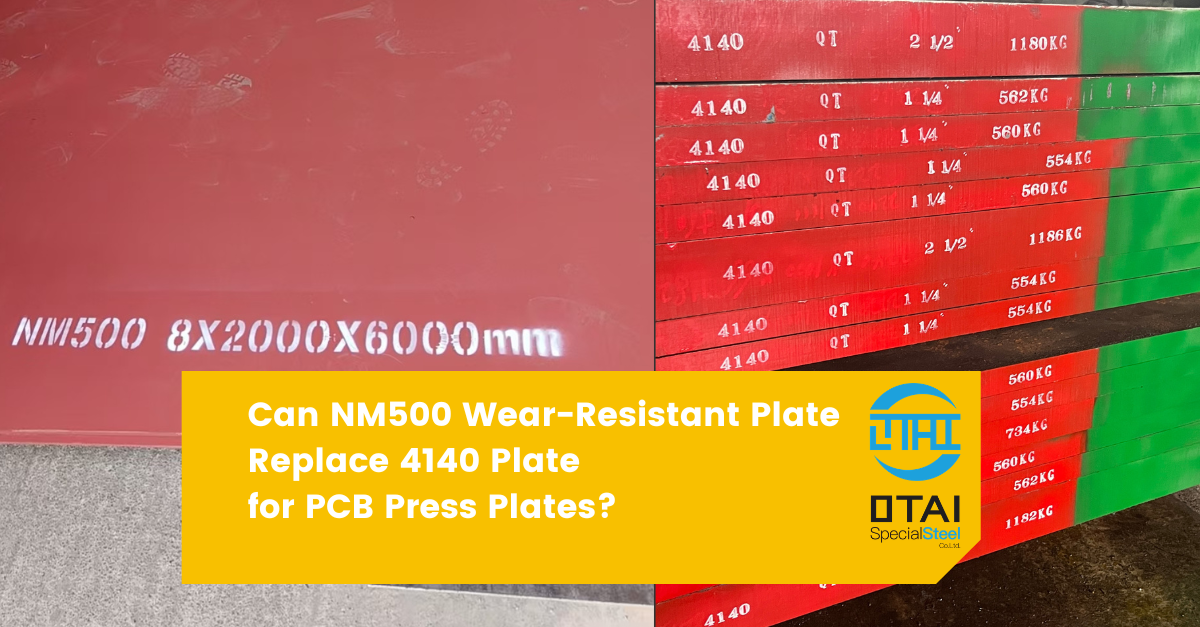
This situation is common enough that some PCB manufacturers have quietly started sourcing NM500 wear-resistant steel plate instead. Not because it is a perfect swap, but because for their specific tolerance range, it skips the heat treatment step entirely and arrives ready to use.
Here we explain when that switch makes sense, and when it doesn’t.
The Short Answer: Yes — With One Condition
NM500 can replace heat-treated 4140 plate for PCB press plates and carrier plates in mid-size manufacturing environments where flatness tolerance is in the 0.1–0.3 mm/m range and parallelism is within 0.1 mm. If your specifications are tighter than that — think high-precision multilayer lamination with parallelism requirements of ≤0.03 mm — NM500 is not the right call, and in this post we will tell you why.
For mid-tolerance applications, NM500 is already harder than required when it arrives at your facility.
Why 4140 Press Plates Need Heat Treatment in the First Place
4140 (DIN 42CrMo4 / 1.7225) is a chromium-molybdenum alloy steel designed for strength and toughness. In its annealed state, the hardness is inconsistent — some plates come in below 200 HBW, others closer to 250 HBW. Neither end of that range reliably meets the 40±2 HRC (approximately 380–400 HBW) specification that PCB press plates and carrier plates typically require.
To get there, the plate has to go through quench and temper (Q&T) heat treatment after you receive it. That process adds cost, adds lead time, and introduces a distortion problem that every tooling engineer in this space has dealt with at least once.
When a steel plate is heated to austenitizing temperature and then quenched, the thermal gradient across the cross-section causes differential expansion and contraction. For a large-format plate — say, anything above 1,000 × 1,000 mm — achieving flatness within ±0.2 mm after quenching requires precision fixturing, controlled atmosphere, and often a stress-relief cycle after the main heat treatment. Even then, a grind allowance is typically built into the plate thickness to recover flatness. That adds cost and cuts into your net usable thickness.
What NM500 Brings to the Table
NM500 is a quenched and tempered wear-resistant steel plate delivered at 450–530 HBW — already at approximately HRC 46–54 when it arrives at your facility. The Q&T process happens at the steel mill during production, not in a separate heat treatment shop after you purchase the plate.
That single difference cuts the entire cycle: no outsourcing to a heat treater, no waiting for quench and temper turnaround, no distortion to grind out.
The hardness NM500 delivers at the mill — 450–530 HBW — sits above the 40±2 HRC (≈ 380–400 HBW) specification for standard 4140H PCB press plates. It more than meets the hardness requirement without any additional processing.
For reference, NM500 is the Chinese national standard (GB) equivalent of internationally recognized grades including AR500 (ASTM), Hardox 500 (SSAB), and Creusabro 4800. It is a through-hardened abrasion-resistant plate, not a surface-hardened product, so the hardness is consistent through the full cross-section.
Where NM500 Works — and Where It Doesn’t
This is the part most articles skip. NM500 is not a universal replacement for 4140H press plates, and the decision comes down to one factor: how tight your dimensional tolerances actually are.
Where NM500 is a viable switch:
Mid-size PCB manufacturers running standard multilayer or double-sided lamination, where press plate flatness is specified at ≤0.3 mm/m and parallelism at ≤0.1 mm, are the natural fit. These operations typically process panel sizes under 1,200 × 1,000 mm and use press plates in the 3–12 mm thickness range. At this specification level, NM500 plate — ordered to size, surface-ground on both faces — performs comparably to heat-treated 4140 at a lower all-in cost.
The cost advantage compounds when you account for procurement simplicity: one supplier, one lead time, no coordination between steel vendor and heat treatment shop.
Where NM500 is not the right choice:
High-precision lamination operations — particularly those producing HDI boards, fine-pitch MLB, or flex-rigid constructions — typically specify press plates to Medal or equivalent standards, with parallelism requirements of ≤0.03–0.05 mm on large-format plates. At this tolerance level, the hardness uniformity of GB-standard NM500 becomes a limiting factor.
Here is the honest technical constraint: NM500 per GB/T 24186 standard is guaranteed at 450–530 HBW, but the point-to-point hardness variation across a large plate can be wider than what a properly heat-treated and ground 4140H or 6150H plate offers. For precision applications, that variation translates to uneven pressure distribution during lamination — which is exactly the kind of defect that shows up as delamination or thickness inconsistency in finished boards.
For those applications, the correct material is still heat-treated 4140H, 6150H (DIN 50CrV4), or purpose-built stainless press plates (e.g., DIN X20Cr13 / Dura 420), processed by a specialist to the dimensional tolerances your process requires.
What to Check Before You Switch
If your tolerance range puts you in the viable category, here is a five-point checklist before placing the first NM500 press plate order:
- Confirm your flatness and parallelism spec. Pull the actual drawing requirement, not the “standard” assumption. If it is ≤0.1 mm parallelism for panels up to 1,000 mm, NM500 is in range. If it is tighter, re-evaluate.
- Request a hardness test report per plate. Ask your supplier for a Brinell hardness report with test points at a minimum of four corners and one center. NM500 should read 450–530 HBW at all five points. A plate with a 90 HBW spread across its surface is worth rejecting.
- Specify surface finish at order. The as-rolled surface of NM500 is not suitable for press plate use. Specify surface grinding to Ra ≤ 2.5 μm (Grit 80 equivalent) on both faces, and confirm the supplier has the grinding capacity for your panel size.
- Check thickness tolerance. Your press plate stack height calculation depends on consistent plate thickness. Specify ±0.2 mm on thickness and verify it at goods receipt with a micrometer, not just a visual check.
- Run a trial batch before full conversion. Order two or three plates for one press configuration, run a full production cycle, and measure yield, surface quality on the PCB, and plate wear after 500 cycles. Only convert the full fleet after the trial confirms performance.
The Last
If your PCB press plate specification sits at 40±2 HRC hardness, flatness ≤0.3 mm/m, and parallelism ≤0.1 mm, NM500 is worth a serious look. The hardness is already there when the plate arrives — you are not paying a heat treater to add it, and you are not absorbing the dimensional risk that comes with large-plate quenching.
If your process requires tighter dimensional control — ≤0.03 mm parallelism on large-format plates, or point hardness uniformity within ±1 HRC across the surface — the savings from skipping heat treatment do not offset the quality risk. Stick with heat-treated 4140H or 6150H specified to precision standards.
The switch is not for everyone. But for mid-size PCB operations running standard lamination, it is a procurement simplification that a small number of manufacturers have already made — and that most suppliers have not thought to suggest.
Interested in NM500 plate specifications, available sizes, and surface finishing options? See our NM500 product page or contact us with your panel dimensions and tolerance requirements. Or just send WhatsApp Message INQUIRY now.